

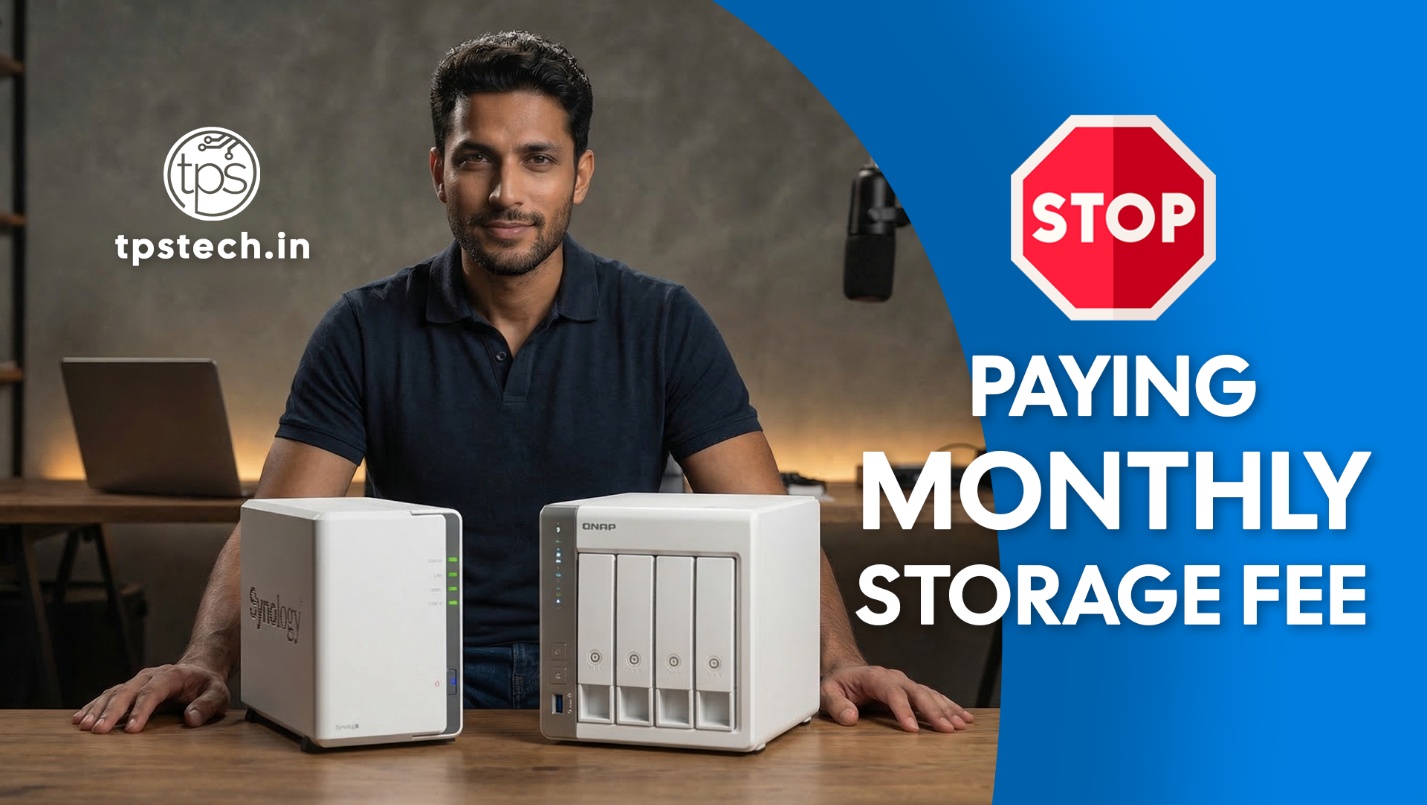
Every few months, the same notification appears on millions of Indian smartphones: “Your storage is almost full.” The default response has always been to pay for another month of Google One or upgrade an iCloud plan. But a growing number of Indian households and small businesses are choosing a different path entirely. They’re buying NAS devices.
A Network Attached Storage (NAS) device is a personal storage server that sits in your home or office and connects to your Wi-Fi network. Once set up, every device on your network, phones, laptops, tablets, and smart TVs, can access, back up, and share files through it. No monthly subscription. No recurring fees. No data leaving your premises.
The global NAS market was valued at approximately $47 billion in 2025, with a projected compound annual growth rate of over 15 per cent through the next decade. The Asia-Pacific region, led by India and China, accounts for the largest and fastest-growing share. Within India, the consumer NAS segment is being driven by over 900 million internet users and an explosion of digital content creation at every level.
The Subscription Trap
Google offers 15 GB of free storage per account, a limit most users exhaust within a year. After that, a Google One 2 TB plan costs ₹6,500 annually. Apple’s iCloud 2 TB plan runs at ₹749 per month. For a family with two or three members on paid plans, the combined annual cost can touch ₹15,000 to ₹25,000. Over five years, that’s ₹75,000 to ₹1,25,000 spent on storage they will never own. If a subscription lapses or the provider changes terms, as Google did when it ended unlimited Photos storage in 2021, users have no recourse.
A NAS device flips this equation. A 2-bay NAS enclosure from Synology or QNAP costs between ₹18,000 and ₹35,000 as a one-time purchase. Pair it with two 4 TB NAS-rated hard drives (₹8,000 to ₹12,000 each), and a household has 4 to 8 terabytes of storage for ₹35,000 to ₹55,000 total. That investment pays for itself within two to three years, and the storage remains yours indefinitely.
Privacy and Security: Why Keeping Files Local Matters More Than Ever
India’s cybersecurity landscape has grown increasingly alarming. According to CERT-In, cyber incidents surged from 1.03 million in 2022 to over 2.27 million by 2024. Cloud misconfigurations remain among the most common causes of data exposure. In 2025, multiple Indian financial institutions suffered breaches due to misconfigured cloud storage, with the average breach cost reaching ₹220 million according to IBM’s annual report.
A NAS device changes this fundamentally. Files sit on hard drives physically inside your home. They do not traverse the public internet unless you explicitly enable remote access, and modern NAS operating systems from Synology (DiskStation Manager) and QNAP (QTS) include built-in encryption, two-factor authentication, and automatic security updates. There is no cloud provider reading metadata, training AI models on your content, or serving targeted advertisements based on your stored files.
India’s Digital Personal Data Protection Act (DPDP), enforced through Rules notified in late 2025, has further heightened awareness around data sovereignty. A NAS provides a straightforward answer to where personal data should live: at home, under the owner’s control.
How Indian Households Are Actually Using NAS Devices
School and college projects: Families accumulate years of academic work across multiple children’s devices. A NAS provides a shared drive where every child can save and access projects from any device. Synology Drive and QNAP File Station sync folders automatically, so a presentation started on a laptop can be reviewed on a tablet without USB drives or email attachments.
Content creators and freelancers: A single 4K video consumes 30 to 50 GB of raw footage. Cloud storage at this scale is prohibitively expensive and slow on typical Indian broadband. A NAS offers local gigabit-speed access (over 100 MB/s on wired connections), letting editors work directly off the device. QNAP’s multimedia NAS models include hardware transcoding for streaming 4K to multiple devices simultaneously.
Smartphone backups: With over 750 million smartphone users in India, this is the most universal use case. Both Synology Photos and QNAP QuMagie automatically back up every photo and video the moment a phone connects to home Wi-Fi, identical to Google Photos or iCloud backup, except files stay on your own hardware with no compression, no fees, and no third-party scanning.
Home offices and small businesses: Chartered accountants, architects, and design studios use NAS units with RAID configurations for data redundancy, meaning even if one hard drive fails, no data is lost. For firms handling sensitive client information, this is far more controlled than a shared cloud plan.
Surveillance and media streaming: Synology’s Surveillance Station supports IP cameras directly, while apps like Plex turn a NAS into a personal streaming server for movies and music across all household devices.
Read the full original article on TPSTech’s blog: Why More Indian Homes and Offices Are Choosing NAS Devices
Where to Buy a NAS in India: The TPSTech.in Advantage
NAS devices are speciality hardware that most large e-commerce platforms carry in limited stock, often from third-party sellers with inconsistent pricing and questionable authenticity. This is the gap that TPSTech.in (TPS Technologies) has filled.
Based in Bengaluru and delivering to 19000+ pin codes in India, TPSTech is India’s leading specialist technology retailers with over 5000 SKUs, a decade+ experience in eCommerce, and their claim of having experience of 15 lakh orders. The company is an authorised seller of both Synology and QNAP NAS systems, meaning every unit comes with a valid manufacturer warranty, genuine firmware, and access to official support.
TPSTech provides pre-sales consultation via phone, email, and WhatsApp, helping first-time buyers choose the right NAS model and compatible hard drives for their specific use case. The company offers express delivery (paid options) across India besides standard free shipping. The NAS category on TPSTech.in (tpstech.in/collections/nas-device) covers the full range, from entry-level 1-bay units to enterprise rackmount solutions, alongside NAS-rated drives from Seagate IronWolf and Western Digital Red series.
Setting Up a NAS at Home: Easier Than You Think
Setting up a Synology DiskStation involves three steps: insert the hard drives (tool-free on most modern models), connect to your router with an Ethernet cable, and run the guided setup wizard from any browser. The entire process takes under 20 minutes. Synology’s DSM and QNAP’s QTS both present intuitive, desktop-like interfaces where creating shared folders, setting up phone backups, and installing applications are all point-and-click operations. Both platforms support secure remote access without requiring technical knowledge of port forwarding or DNS configuration.
Luckily for buyers unsure about the process, TPSTech.in also offers remote guidance that goes beyond model selection. Their team walks first-time buyers through what to expect after unboxing, which drives are compatible, and how to configure essentials like phone backups and shared folders. This hands-on support is a key reason why many Indian households choose to buy their first NAS through TPSTech rather than navigating a generic marketplace alone.
The Bigger Picture: Data Independence in a Subscription-Driven World
In a world where nearly every digital service operates on a subscription model, NAS represents one of the few remaining areas where users can own infrastructure outright. There is no monthly toll, no algorithmic curation of your files, and no terms of service that can change overnight.
As retailers like TPSTech.in continue to make NAS hardware accessible, affordable, and well-supported across India, the NAS device is steadily moving from niche product to household essential. The question for most families is no longer whether they need one, but when they’ll finally set one up.
Read the full original article on TPSTech’s blog: Why More Indian Homes and Offices Are Choosing NAS Devices
About TPSTech
TPSTech (tpstech.in) is a Bengaluru-based specialist technology retailer offering authentic PC components, peripherals, networking equipment, and storage solutions across India. With over 10,000 SKUs, 15 lakh+ fulfilled orders, and authorised partnerships with Synology, QNAP, Seagate, Western Digital, and TP-Link, TPSTech combines product authenticity with expert consultation and rapid nationwide delivery. Visit http://www.tpstech.in for more information.
Media Contact
Website: www.tpstech.in
NAS Devices: tpstech.in/collections/nas-device
Synology NAS: tpstech.in/collections/synology-nas-enclosures
